

Vocana® WPC Solutions
By Global Climate
By Application Gallery

Tropical Humid Climate Solutions
WPC Exterior Systems for Tropical Humid and High-Moisture Environments
Tropical and humid regions create some of the most demanding conditions for exterior building materials. Continuous exposure to high humidity, heavy rainfall, mold growth, biological attack, and intense sunlight can accelerate the deterioration of traditional wood, painted surfaces, and conventional facade materials.
This solution focuses on designing durable WPC exterior systems for tropical buildings that combine moisture resistance, UV stability, ventilation, and low-maintenance performance. It provides reliable facade, ceiling, decking, and outdoor architectural solutions for residential, hospitality, commercial, and landscape projects in warm, humid regions.

Coastal & Marine Climate Solutions
WPC Cladding Systems for Coastal and Marine Exposure
Buildings located near oceans and coastal areas face unique durability challenges due to salt spray, high humidity, strong winds, and continuous exposure to moisture. Traditional timber and metal materials often experience corrosion, swelling, cracking, or accelerated surface degradation in marine environments.
This solution provides engineered WPC facade and outdoor systems designed for coastal applications, with a focus on corrosion resistance, moisture protection, dimensional stability, and long-term appearance retention. It is suitable for seaside residences, resorts, hotels, marinas, commercial buildings, and public spaces exposed to marine climates.

WPC materials for Hospitality Buildings
WPC Solutions for Hotels, Resorts & Hospitality Architecture
Hospitality buildings require exterior materials that combine architectural aesthetics, durability, and low lifecycle maintenance. This category covers luxury hotels, boutique hotels, business hotels, beach resorts, eco-resorts, spa resorts, hotel villas, and tourism developments. These projects often face challenges including high UV exposure, coastal humidity, salt air, and intensive outdoor usage. WPC solutions provide durable applications for exterior facades, ceilings, privacy screens, balconies, decking, and landscape areas, helping hospitality projects achieve a natural wood appearance with improved weather resistance and long-term performance.

WPC Materials for Commercial Buildings
WPC Solutions for Offices, Retail Centers & Mixed-Use Developments
Commercial buildings rely on exterior materials that support architectural identity, durability, and cost-effective maintenance. This category includes office buildings, corporate headquarters, shopping malls, retail stores, restaurants, commercial plazas, and mixed-use developments. These projects require facade systems and outdoor elements that maintain appearance under continuous public exposure. WPC solutions are suitable for exterior cladding, decorative ceilings, entrance features, privacy screens, terraces, and landscape applications, combining modern architectural design with long-term outdoor performance.

WPC materials for Residential Buildings
WPC Solutions for Villas, Houses & Residential Communities
Residential architecture increasingly requires exterior materials that enhance design quality while reducing maintenance demands. This category includes luxury villas, detached houses, townhouses, apartments, condominiums, residential estates, and vacation homes. Exterior systems must withstand different climate conditions such as sunlight, rain, humidity, and temperature changes while maintaining visual appeal. WPC solutions are widely used for exterior wall cladding, balcony screening, fencing, terraces, outdoor ceilings, and landscape structures, providing a durable alternative to traditional timber.

WPC materials for Public Buildings
WPC Solutions for Civic Architecture & Community Facilities
Public buildings require reliable exterior materials designed for long service life, public accessibility, and changing environmental conditions. This category includes government buildings, libraries, civic centers, exhibition halls, convention centers, and community facilities. These projects often require durable, low-maintenance materials that also contribute to attractive public environments. WPC systems provide solutions for facades, exterior ceilings, entrance structures, screening elements, and outdoor spaces, supporting sustainable and functional public architecture.

WPC materials for Cultural & Heritage Buildings
WPC Solutions for Museums, Historic Renovation & Cultural Architecture
Cultural and heritage projects require materials that respect architectural character while improving durability and maintenance efficiency. This category includes museums, historic buildings, cultural centers, memorials, temples, churches, and restoration projects. Traditional timber elements often face challenges such as aging, moisture damage, and regular maintenance requirements. WPC solutions provide wood-inspired finishes for facades, decorative structures, ceilings, and landscape applications, helping architects balance heritage aesthetics with modern material performance.
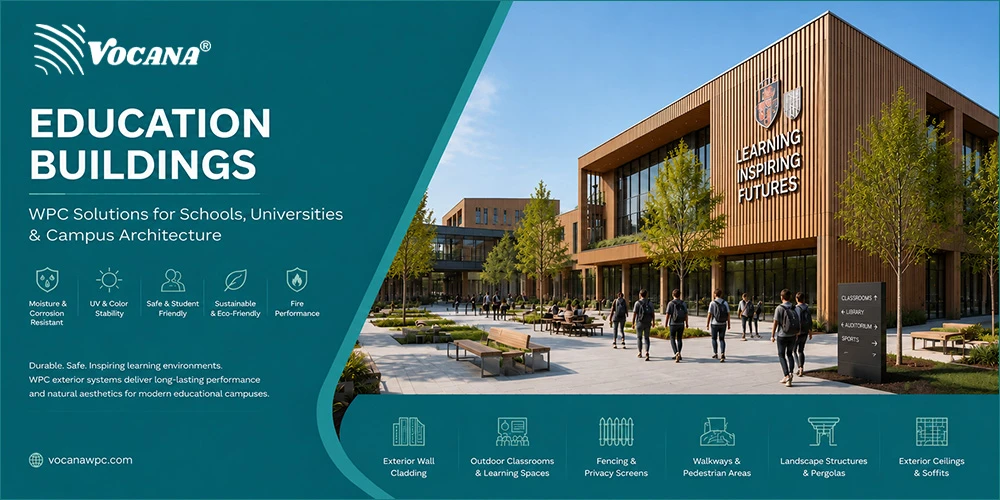
WPC materials for Education Buildings
WPC Solutions for Schools, Universities & Campus Architecture
Educational buildings require safe, durable, and low-maintenance exterior systems suitable for long-term daily use. This category includes schools, universities, colleges, research campuses, libraries, kindergartens, and student facilities. Educational environments often require materials that withstand weather exposure, frequent activity, and long operational cycles. WPC solutions are applied in façades, outdoor learning areas, walkways, fencing systems, privacy screens, and landscape structures, creating durable and visually comfortable campus environments.

WPC materials for Healthcare Buildings
WPC Solutions for Hospitals, Clinics & Wellness Facilities
Healthcare buildings demand exterior materials that support durability, cleanliness, and long-term operational efficiency. This category includes hospitals, medical centers, clinics, rehabilitation facilities, nursing homes, wellness centers, and healthcare campuses. These projects require reliable materials that minimize maintenance interruptions while creating comfortable architectural environments. WPC systems provide applications for facades, exterior ceilings, screening structures, terraces, and outdoor patient areas, combining natural appearance with resistance to moisture, weathering, and daily environmental exposure.

WPC materials for Industrial & Logistics Buildings
WPC Solutions for Factories, Warehouses & Industrial Facilities
Industrial and logistics projects require exterior systems that deliver durability, functional performance, and improved architectural appearance. This category includes factories, warehouses, logistics centers, distribution hubs, manufacturing facilities, and industrial parks. These buildings often face demanding conditions, including temperature changes, weather exposure, and large-scale maintenance requirements. WPC solutions can enhance industrial facades, office areas, fencing systems, screening structures, and outdoor spaces, providing a practical balance between performance and modern design.
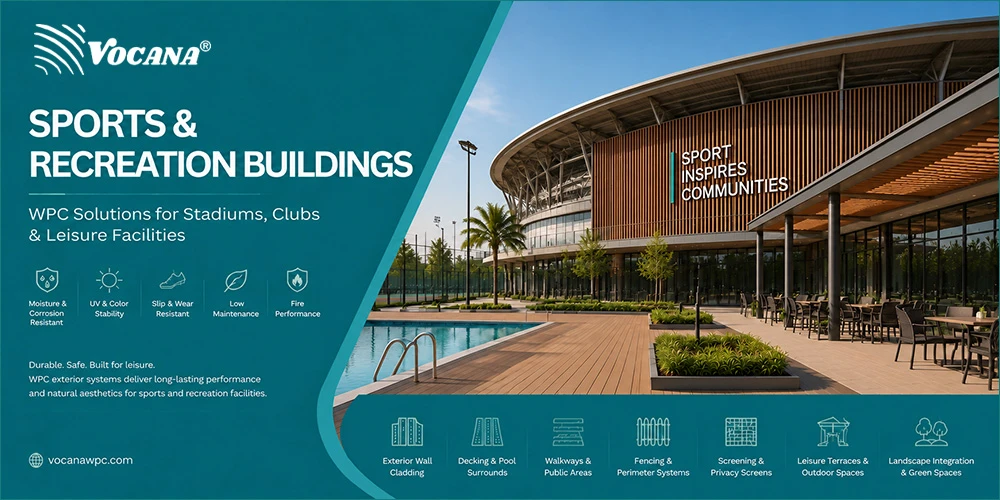
WPC materials for Sports & Recreation Buildings
WPC Solutions for Stadiums, Clubs & Leisure Facilities
Sports and recreation facilities require exterior materials that withstand intensive public use, outdoor exposure, and changing environmental conditions. This category includes stadiums, sports centers, swimming pools, golf clubs, yacht clubs, fitness facilities, and leisure complexes. These projects often combine architectural design with functional outdoor spaces. WPC solutions are suitable for façades, decking areas, pool surroundings, walkways, fencing, and screening systems, providing durable and attractive solutions for recreational environments.
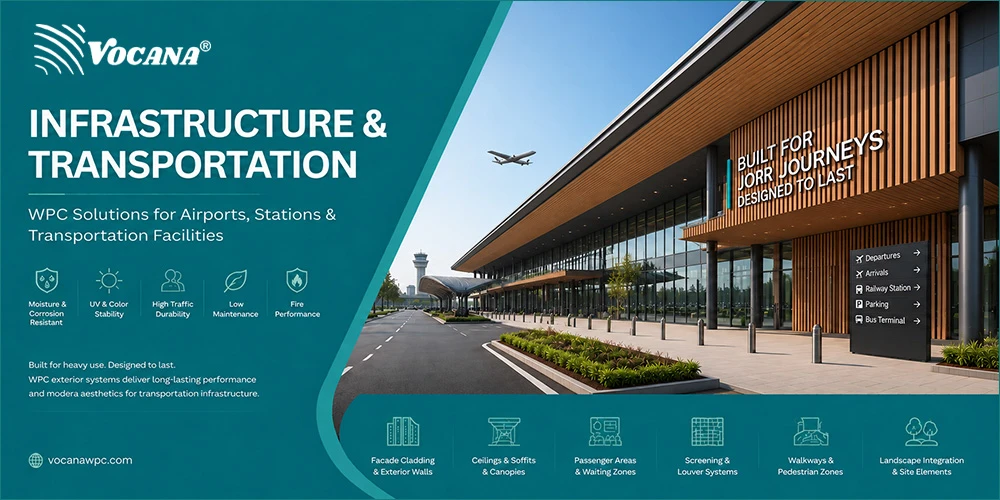
WPC materials for Infrastructure & Transportation facilities
WPC Solutions for Airports, Stations & Transportation Facilities
Transportation infrastructure requires exterior materials capable of performing under heavy public use and demanding environmental conditions. This category includes airports, railway stations, metro stations, bus terminals, parking structures, ports, and transportation hubs. These projects require durable, low-maintenance systems suitable for large-scale applications while maintaining architectural quality. WPC solutions support facade cladding, ceiling systems, screening structures, pedestrian areas, and public spaces with reliable weather resistance and long-term performance.
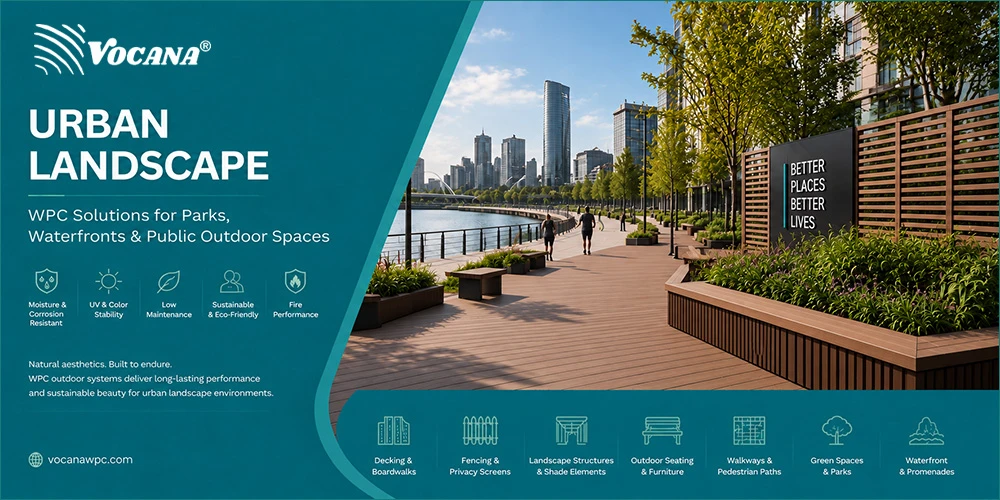
WPC materials for Urban Landscape projects
WPC Solutions for Parks, Waterfronts & Public Outdoor Spaces
Urban landscape projects require durable outdoor materials that integrate natural appearance with long-term environmental performance. This category includes parks, waterfront promenades, boardwalks, plazas, greenways, pedestrian streets, and public recreational areas. Outdoor environments face continuous exposure to rain, sunlight, humidity, and public usage. WPC solutions provide applications for decking, fencing, privacy screens, landscape structures, walkways, and architectural features, helping create attractive public spaces with reduced maintenance requirements.
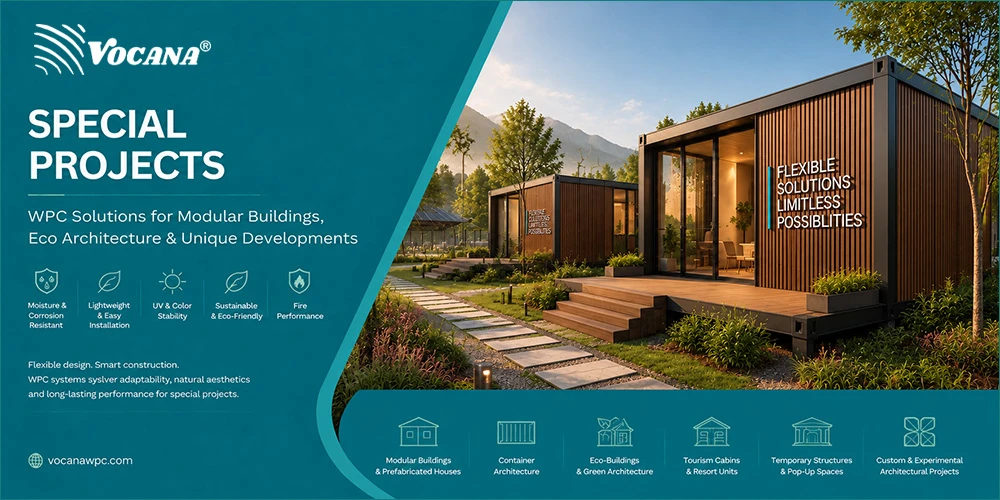
WPC materials for Special Projects
WPC Solutions for Modular Buildings, Eco Architecture & Unique Developments
Special projects often require flexible exterior materials adapted to innovative construction methods and unique architectural concepts. This category includes modular buildings, prefabricated houses, container architecture, eco-buildings, tourism cabins, remote facilities, and customized developments. These projects may require lightweight installation, weather resistance, and design flexibility. WPC systems provide adaptable solutions for exterior cladding, ceilings, decking, fencing, and screening applications, supporting modern sustainable and unconventional architectural designs.
ECO WPC Panels systems
We do not start a WPC project by asking which board you want. We start by asking what the building needs.
A hotel near the sea, a shopping mall facade, a rooftop terrace and a family garden all use WPC in different ways. Sun, rain, humidity, wind, foot traffic, fire rules, cleaning and future repair can all change the right product choice.
For us, a WPC solution means connecting the material, profile, color, accessories, substructure, installation and project delivery into one system. The product is important, but most of our work happens before and after the board leaves the extrusion line.
Which WPC System Fits Your Building?
WPC is not one product. We make different profiles and material systems for walls, floors, ceilings, fences and landscape structures. The first step is to match the product family to the real job.
For rain, UV and building-envelope work, start with our exterior WPC cladding systems.
For terraces, pools, public spaces and hospitality projects, review our commercial WPC decking solutions.
For covered outdoor areas and commercial interiors, see our outdoor WPC ceiling and soffit systems.
For privacy, boundaries and public landscapes, explore our WPC fencing systems.
We pay more attention to drainage, ventilation, UV, pigment stability and moisture management. See our WPC systems for tropical humid climates.
We look at the WPC and the metal system together because salt often attacks clips, screws and subframes first. See our coastal and marine WPC solutions.
Pool decks, facades, ceilings and privacy screens have different risks. Our WPC solutions for hotels and resorts separate them by application zone.
We do not use "anti-slip" as a simple sales claim. Surface, wet condition and test method need to match. Review our anti-slip WPC decking for poolside projects.
Why Does Vocana Spend So Much Time on the Factory Side?
Because the finished profile starts much earlier than extrusion.
A different resin, wet wood fiber, wrong pigment ratio, worn mold or unstable cooling can all change what finally arrives on site.
We therefore connect raw materials, formulation, tooling, production and QC instead of treating them as separate jobs.
Our main WPC manufacturing and R&D work is centered in Ningbo. Xiamen Vocana handles international quotations, export coordination, documents and overseas project communication. For Australian technical development, Innowood Australia has also been a long-term R&D cooperation partner.
We keep those roles clear because technical work and export work need different teams, but the project must still move as one chain.
How Do We Choose Raw Materials for Different WPC Projects?
We do not buy one "WPC recipe" and use it for every product. Outdoor HDPE decking, PVC wall or ceiling profiles, capped products and fire-sensitive products need different material packages.
We check whether the resin family fits the product and whether incoming batches stay consistent with the approved formula. A recycled polymer can work well when its source and melt behavior are controlled; mixed unknown waste is a different risk.
We look at moisture, particle size, cleanliness and how evenly the fiber mixes with the polymer. Wet or poorly controlled fiber can make production less stable.
Fillers such as calcium carbonate can help processing and cost control, but too much filler can make a profile heavier and more brittle. Heavier does not always mean stronger.
UV stabilizers, coupling agents, lubricants, antioxidants, pigments and other additives are selected around the real application. High-UV and fire-sensitive projects need different priorities.
What Happens Before a WPC Production Line Starts?
Before we release a project to production, we want the factory order to match what the buyer approved.
This early work reduces a common problem in project purchasing: buying the board first and finding out later that the length, fixing system, test report or installation method does not fit the job.
How Do We Develop a Custom WPC Profile?
When an architect or contractor needs a new section, we start with how the profile will be used. We look at the visible face, wall thickness, ribs, connection points, reinforcement, fixing method and installation accessories.
We check whether the shape can be extruded, cooled and fixed in the way the project expects.
The mold is linked to the real cross-section, wall thickness and surface requirements rather than only the outside size.
We check fit, straightness, profile weight, surface and installation logic before mass production.
The buyer has one real reference for color, profile, grain and connection. The same sample becomes useful to production and later site inspection.
After approval, profile, color, length, surface, quantity, accessories and packing should not change casually once production has started.
What Happens During WPC Extrusion?
Our normal production flow connects material preparation all the way to packing:
During extrusion, we do not only look at the face of the board. Profile shape, weight per meter, wall and rib condition, surface and color can all tell us whether the process is staying stable.
How Do We Control WPC Quality Beyond a Visual Check?
"Strict QC" means very little unless we say what is actually checked. Different profiles have different risks, so we use model-specific inspection points.
For project buyers, this is more useful than a general quality promise because it gives the factory, buyer and site team measurable items to check.
Why Do We Ask Buyers to Approve a Real WPC Sample?
A screen cannot show everything. A physical sample lets you see grain depth, gloss, edge shape, wall thickness, weight and how the color changes under your real building light.
For large facades, ceilings, fences or public decks, we often recommend a small mock-up as well. A mock-up can show:
- board or panel direction;
- joint alignment;
- corner treatment;
- subframe depth;
- clips and visible fixings;
- color beside other building materials;
- real installation workmanship.
Once the sample or mock-up is accepted, it becomes a useful reference during production and site inspection.
How Do We Handle Large or Phased WPC Projects?
A project that needs several containers over several months has different risks from a one-time order.
| Project Risk | What We Do | Why It Matters |
|---|---|---|
| Color differences | Keep one approved sample and master color reference. | Later batches can be checked against the same target. |
| Profile changes | Keep the same profile code, drawing and production specification. | Site teams do not receive different sections under one product name. |
| Accessory mismatch | Record clips, trims, joists, rails or posts with the main profile. | The board and fixing system arrive as one usable package. |
| Site storage | Production and shipping can be arranged by project phase. | The site does not need to store every container at the start. |
| Mixed project zones | Group cartons and labels by profile, color or installation phase. | Priority materials are easier to find at destination. |
We also try not to mix widely separated production lots across one continuous facade or deck when visual color continuity is important.
How Do We Use WPC Test Reports Correctly?
A test report is useful only when it can be connected to the product you are actually buying.
Before we use a report in a project file, we check the applicant, sample description, profile or formulation, standard, test date and result. An older report can show manufacturing history, but it should not be renamed as current proof for an unrelated SKU.
Project specifications may refer to ASTM methods for weathering, composite decking, moisture or other performance checks.
ASTM InternationalISO standards can support quality, environmental management and product-related documentation when the exact standard and scope are clear.
International Organization for StandardizationEuropean projects may refer to EN standards for product, fire or pedestrian-surface requirements. The required standard should be confirmed before product approval.
CEN and CENELECFor product-specific evidence available from Vocana, use our WPC certificates and testing reports. We recommend confirming which report applies to the final selected profile rather than treating every certificate as valid for every product.
How Do We Prepare a WPC Project Submittal?
Architects, contractors and project owners often need more than a quotation. We can organize the technical file around the actual product being offered.
Profile drawing, dimensions, material family, surface, color and product code.
Accessories, fixing details, subframe guidance, movement gaps, drainage and other product-specific installation information.
Applicable QC limits, approved sample reference and available test reports for the selected product.
Packing, labels, quantity, production plan, shipment information and warranty conditions.
A clear technical file saves repeated questions because design, purchasing, factory and site teams can all work from the same reference.
What Happens Between Final QC and the Construction Site?
For long WPC profiles, delivery is part of quality control. A straight profile can still arrive damaged if it is packed or handled badly.
When several products share one container, we plan carton grouping and loading order so the first materials needed on site are not hidden behind later-phase goods.
For more examples of how products, accessories and project zones are coordinated, see our WPC building project systems.
What Can We Do Before Installation Starts?
Our normal support includes installation manuals, flowcharts, detail drawings, videos and online technical guidance for relevant WPC systems.
We prefer the installer to receive these materials before site work begins. That gives the team time to check subframe spacing, board direction, movement gaps, fixing points, drainage and finishing details before material is cut.
How Do We Handle Maintenance and After-Sales Problems?
When a site reports a problem, we first try to find the cause before suggesting replacement.
Was the right product and formulation used for the application?
Does the reported profile match the production order, sample and batch record?
Was the material damaged during container loading, unloading or site storage?
Are support spacing, gaps, fixing points, drainage and ventilation correct?
Has dirt, standing water, impact, chemicals or blocked drainage changed the site condition?
Useful after-sales information includes the profile code, batch or order reference, project location, installation date, photos, measurements and when the problem first appeared.
What Should Buyers Confirm Before Ordering WPC?
- building type;
- project location;
- indoor or outdoor use;
- fully exposed or covered area;
- profile code;
- solid or hollow structure;
- surface and color;
- board or panel length;
- estimated quantity;
- clips and trims;
- joists, rails or posts;
- installation direction;
- required test reports;
- packing requirement;
- destination port or address;
- target delivery date;
- spare material requirement;
- sample or mock-up approval.
For regular catalog profiles, our common project MOQ is about 1,000 m² or the equivalent production length. Custom profiles or colors can need a larger batch because mold, color and production setup create fixed costs. Final MOQ should always be confirmed for the exact product.
For regular established profiles, production planning is commonly around 15–20 working days for a 20-foot container or smaller shipment and around 20–25 working days for a 40-foot container. New molds, special colors, mixed profiles or additional testing can add time.
Why Do We Treat Design, Production and Delivery as One Chain?
Our experience is that one decision often changes the next one.
That is why we prefer to work from the building conditions and drawings instead of sending a large catalog and asking the buyer to choose alone.
FAQ: Vocana WPC Solutions for new or renovation buildings
Does Vocana use the same WPC material for every application?
No. Outdoor decking, exterior cladding, ceilings, fencing and fire-sensitive projects can need different polymer, fiber, additive, surface and profile designs. We select the material around the application and climate.
Can Vocana develop a custom WPC profile from a drawing?
Yes, when the project volume and technical conditions are suitable. We review the cross-section, wall thickness, fixing method and application before mold development and trial extrusion.
How does Vocana control color for a large WPC project?
We prefer a physical approved sample. For phased orders, the same profile, color, surface and approved reference should stay connected to later production batches.
Does every Vocana WPC product have the same test results?
No. Test results belong to the tested sample, profile or formulation. We check the report scope before using it in a project submittal.
Can Vocana support installation after delivery?
For relevant WPC systems, we can provide installation manuals, drawings, videos and online technical guidance. Larger or repeat projects can also discuss installer training options.
What information should I send before asking for a WPC quotation?
Send the project location, building type, application, drawings, estimated area, climate exposure, preferred finish, installation plan, required standards and target delivery date. These details help us quote the correct system instead of only a board price.
Send Us the Building Conditions Before You Choose the WPC
Share the project location, drawings, application areas, estimated quantity and the problems you need to solve. We can review the material family, profiles, samples, accessories, production plan, test documents and delivery needs before the quotation is fixed.
Discuss My WPC Project