Anti-Slip Decking Solutions for Swimming Pool Areas


page-753-502


Anti-Slip & Waterproof Poolside Composite Decking

In commercial aquatic facilities, resort decks, rooftop swimming pools, and public wellness centers, anti-slip WPC decking is no longer selected purely for appearance. The main engineering concern is long-term surface safety under constant moisture exposure, chlorine contact, UV radiation, and barefoot traffic. Traditional timber decking often develops splintering, biological decay, algae adhesion, and unstable friction coefficients within a few maintenance cycles.

For architects and contractors managing hospitality, municipal, or mixed-use developments, poolside decking failure creates three direct liabilities:

Slip-and-fall injury risk

High annual maintenance labor

Premature material replacement due to moisture degradation

Modern co-extruded composite decking systems address these problems through controlled surface texture engineering, capped polymer protection layers, and stabilized wood-polymer composite cores designed for exterior wet-zone applications.

EN 16165 wet barefoot slip resistance rated up to Class C / R11, suitable for commercial pool circulation zones.

Water absorption rate below 1.0% according to ASTM D570, reducing edge swelling and surface deformation.

Co-extruded exterior composite WPC tested under 2000-hour QUV accelerated weathering with stable color retention.

Flexural strength exceeding 28 MPa under ASTM D7032, suitable for high-footfall hospitality decking systems.


Key Takeaways for Architects & Contractors


Commercial poolside WPC decking should achieve at least R11 slip resistance and maintain stable friction values under wet barefoot conditions according to EN 16165.

First-generation uncapped WPC products often fail around pool environments because chlorine, UV radiation, and moisture accelerate polymer oxidation and surface chalking.

Co-extruded waterproof decking systems reduce lifecycle maintenance costs by eliminating sanding, sealing, and annual anti-fungal coating cycles typically required for hardwood decking.


The Mechanics of Failure in Swimming Pool Decking Systems


Why Traditional Timber Fails Around Swimming Pools


Natural hardwood remains common in luxury hospitality projects, but its cellular structure creates predictable failure mechanisms in continuously wet environments.


1. Moisture Penetration and Fiber Swelling

Timber absorbs water through capillary action. In swimming pool areas, repeated wet-dry cycles cause:

Cell wall expansion

Internal stress accumulation

Surface checking

End cracking

Once moisture content deviates from dimensional stability thresholds, deck boards begin to cup and warp. This directly affects walking safety and fastening integrity.


2. Biological Growth and Slip Risk

Poolside timber surfaces continuously accumulate:

Algae

Mold spores

Biofilm residues

Sunscreen contamination

Even anti-slip grooves become ineffective once biological buildup fills the surface texture. Maintenance teams often compensate through aggressive pressure washing, which further damages wood fibers.


3. UV Photodegradation

High-UV environments such as:

Dubai hotel podium decks

Caribbean resort pools

Australian aquatic facilities

accelerate lignin decomposition inside hardwood surfaces. The result is:

Color instability

Fiber erosion

Surface roughness

Splinter formation

For barefoot users, splintering poses a major liability.


Why First-Generation WPC Systems Also Failed


Early-generation composite decking solved some decay issues but introduced new engineering problems.


Common Failure Mechanisms

Failure Type Engineering Cause Result
Surface fading Polymer oxidation Uneven appearance
Water staining Open fiber exposure Permanent discoloration
Edge swelling Uncapped core absorption Board deformation
Thermal instability Poor polymer ratio control Excessive expansion
Mold adhesion Porous outer layer Slippery walking surface

Many early products used low-density PE matrices with inconsistent wood flour dispersion. In chlorine-rich pool environments, polymer degradation accelerated rapidly.


Engineering Solution: Co-Extruded Poolside WPC Decking


Modern poolside WPC systems rely on multi-layer composite engineering rather than decorative surface treatment alone.


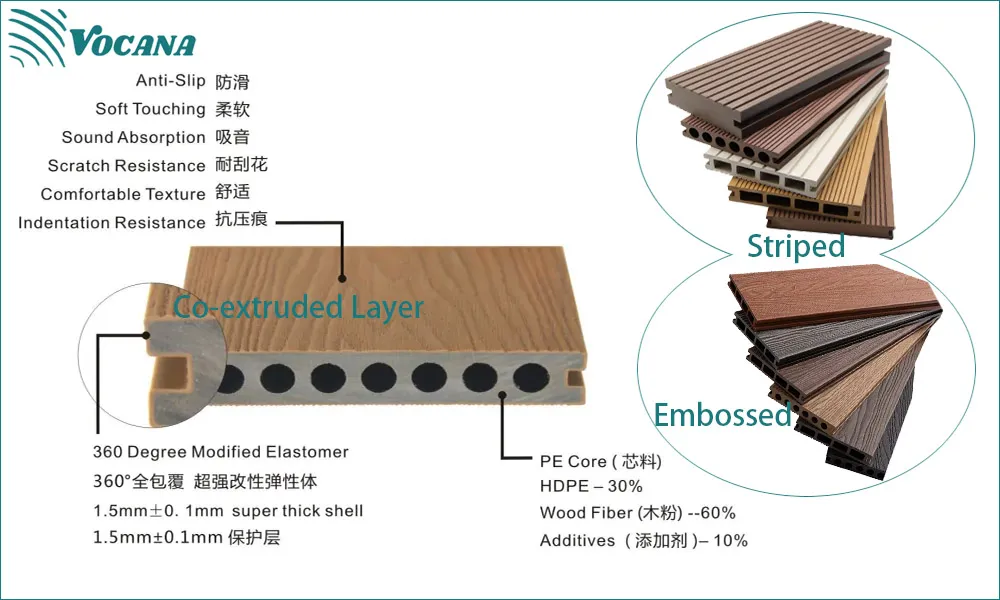
Co-extruded anti-slip WPC decking structure for commercial swimming pool applications

Co-Extrusion Protective Cap Technology

The outer cap layer functions as a sealed polymer barrier protecting the structural composite core.

Main Functions of the Cap Layer

Blocks moisture penetration

Reduces chlorine interaction

Improves stain resistance

Stabilizes UV performance

Maintains textured anti-slip surface geometry

This structure is especially important for waterproof decking systems exposed to:

Saltwater splash zones

Pool cleaning chemicals

Freeze-thaw cycles

Constant barefoot circulation


Surface Friction Engineering

Poolside slip resistance depends on more than deep grooves.

Excessively aggressive textures often trap contaminants and become difficult to clean. Modern anti-slip composite decking instead uses controlled micro-embossing combined with polymer hardness calibration.

Typical commercial targets include:

Area Type Recommended Slip Rating
Hotel swimming pools R11
Public aquatic centers R11-R12
Rooftop leisure decks R10-R11
Spa circulation zones Class C barefoot standard


Thermal Stability WPC DECKING

Thermal Stability in High-Temperature Regions

Dark-colored decking near pools often reaches surface temperatures exceeding 60°C under direct solar exposure.

Exterior composite WPC systems designed for Middle Eastern and tropical applications typically include:

UV stabilizers

Heat-reflective pigments

High-density polymer matrices

Controlled thermal expansion coefficients

This minimizes:

Board distortion

Fastener loosening

Joint irregularity


Technical Specifications Table & Internal Link Matrix


Engineering Parameter Test Standard Vocana Performance Recommended Product
Slip Resistance EN 16165 R11 Wet Surface Co-Extruded Anti-Slip Decking
Flexural Strength ASTM D7032 > 28 MPa Solid-Core Composite Decking
Water Absorption ASTM D570 < 1.0% Waterproof Poolside WPC Decking
UV Weathering ASTM G154 2000h QUV Stable Exterior Composite WPC
Surface Hardness ASTM D2240 High Abrasion Resistance Commercial Decorative Decking
Thermal Expansion ASTM D696 Controlled Linear Stability Hollow & Solid Decking Systems
Biological Resistance EN 15534 No Rot / No Insect Damage Capped Composite Decking
Fire Performance EN13501-1 Available Bfl-s1 Grade Commercial Fire-Rated Decking


  Click for more Vocana WPC Panels Certificates & Testing Reports


Recommended Poolside WPC Configurations


Solid-Core Decking For High-Traffic Hospitality Projects

Solid-Core Decking for High-Traffic Hospitality Projects

Recommended for:

Luxury hotels

Water parks

Municipal aquatic centers

Rooftop commercial pools

Advantages:

Higher point-load resistance

Improved fastening stability

Reduced vibration

Better structural rigidity

Typical joist spacing:

300 mm for commercial wet zones

250 mm near stair transitions

Hollow Composite Decking for Residential or Low-Load Areas

Suitable for:

Private villas

Small spa decks

Low-footfall recreational zones

Benefits include:

Reduced structural dead load

Faster installation

Lower material consumption

However, hollow profiles require careful drainage detailing in pool environments.

Hollow Composite Decking


Expert Engineering Tip from Vocana Engineering Team


In commercial swimming pool projects, never install poolside WPC decking with perfectly parallel board orientation to the pool edge when the walking path exceeds 8 meters. A 30° to 45° diagonal layout reduces standing water accumulation lines, improves drainage efficiency, and minimizes visual expansion movement under high solar exposure. For chlorine-rich environments, stainless steel 316 fasteners should always be specified instead of standard galvanized clips.


  Check for more Vocana WPC Panels


Case Reference: Coastal Resort Swimming Pool Decking


Southeast Asia High-Humidity Resort Application

A beachfront hospitality project in Southeast Asia replaced natural teak decking after repeated failures caused by:

  Salt-air corrosion

  Surface cracking

  Algae buildup

  Annual refinishing shutdowns


Original Timber Deck Maintenance Issues

Maintenance Item Annual Frequency
Sanding & resealing 2 cycles
Damaged board replacement Every 18-24 months
Anti-fungal chemical treatment Quarterly
Slip-related complaints Seasonal increase

The resort transitioned to co-extruded poolside WPC decking with:

  R11 anti-slip surface

  Stainless steel concealed fixing system

  3 mm expansion gap engineering

  UV-stabilized capped layer


Project Outcome After Installation

  Reduced annual maintenance labor hours

  No visible edge swelling after tropical monsoon exposure

  Improved barefoot comfort

  Stable appearance under high UV index conditions


tropical-resort-poolside-wpc-decking


TCO & ROI Analysis: WPC vs Hardwood Pool Decking


For developers and facility operators, initial material cost alone does not reflect actual long-term expenditure.

20-Year Lifecycle Cost Comparison

Cost Category Hardwood Decking Poolside WPC Decking
Initial Material Cost Medium-High Medium
Annual Sealing Required Not Required
Surface Sanding Frequent Not Required
Splinter Repairs Common None
Board Replacement Periodic Minimal
Chemical Treatment Required Not Required
Labor Downtime High Low
Slip-Risk Maintenance Ongoing Reduced
Estimated 20-Year TCO High Lower


For hospitality operators, the largest savings usually come from:

  Reduced operational shutdowns

  Lower maintenance labor

  Lower chemical usage

  Reduced liability exposure


Design Considerations for Commercial Decorative Decking


Drainage Engineering

Pool decks should maintain a minimum drainage slope between:

  1%

  2%

Improper slope design often causes:

  Standing water

  Mineral deposits

  Accelerated contamination accumulation


Expansion Gap Control

Exterior composite WPC expands under temperature variation.

Typical recommendations:

Installation Condition Recommended Gap
Board-end spacing 5-8 mm
Side spacing 4-6 mm
Tropical climate adjustment Additional tolerance required


Gap calculations should consider:

  Solar exposure orientation

  Board length

  Regional temperature range


Barefoot Comfort

Commercial pool environments require balancing:

  Slip resistance

  Surface texture

  Thermal comfort

Overly aggressive embossing can increase the risk of abrasion for barefoot users, especially children and spa guests.


Detailed installation drawing showing joist spacing and drainage slope


  Click for Detailed Vocana WPC Decking Installation Guide


Poolside composite decking applications & Project gallery


swiming pool composite decking
swiming pool wpc decking
wpc decking for coastal
composite decking for coastal
composite decking for resorts
anti-slip wpc decking


  Click for more Vocana Composite Decking Projects


FAQ for poolside WPC composite decking


  What is the required joist spacing for solid WPC decking when installed in a high-traffic commercial swimming pool project?

For commercial aquatic facilities with continuous pedestrian circulation, solid-core anti-slip WPC decking should generally use joist spacing of 250-300 mm center-to-center. Stair edges, access ramps, and pool transition zones often require tighter spacing to reduce dynamic deflection and improve long-term fastening stability.


  How does co-extruded poolside WPC decking perform in chlorine-rich and salt-air environments compared with hardwood decking?

Co-extruded waterproof decking systems isolate the composite core using a protective polymer cap layer, reducing chlorine penetration, salt crystallization, and biological growth. Hardwood decking absorbs moisture and salts through open grain structures, leading to swelling, cracking, coating failure, and repeated maintenance cycles in coastal resort applications.


  Can anti-slip composite decking still become slippery after algae accumulation around swimming pools?

Yes. Any exterior flooring material can lose traction when organic contamination accumulates. However, capped anti-slip WPC decking reduces algae adhesion because the non-porous surface limits biological penetration. Proper drainage slope design, periodic low-pressure cleaning, and airflow beneath the decking system remain essential.


  What thermal expansion allowance should contractors consider for exterior composite WPC near swimming pools?

Thermal movement depends on board length, solar exposure, and regional climate. In high-temperature regions, installers should maintain 5-8 mm board-end gaps and avoid rigid perimeter locking. Dark-colored decking installed under direct sun typically requires larger movement tolerances than shaded installations.


  Which slip resistance standard is typically requested for commercial hotel and resort swimming pool decking systems?

Many hospitality and public aquatic projects target EN 16165 R11 or Class C barefoot ratings for wet circulation zones. Final requirements vary by local building codes, project specifications, and insurance liability standards, especially for municipal and commercial wellness facilities.


  Why do some first-generation composite decking products show edge swelling around pool environments?

Early-generation uncapped WPC products allowed moisture penetration into exposed composite fibers. Repeated wet-dry cycles caused dimensional instability, edge deformation, and surface staining. Modern capped exterior composite WPC systems significantly reduce this issue through sealed co-extrusion technology.


  Is solid-core composite decking always better than hollow decking for poolside construction?

Not always. Solid-core systems provide better structural rigidity and higher impact resistance for commercial applications, while hollow decking reduces dead load and installation costs in lower-traffic projects. Structural load calculations, joist design, and environmental exposure should determine profile selection.


  How can contractors reduce standing-water issues in large commercial decorative decking layouts?

Large-format pool decks should integrate directional drainage planning, diagonal board orientation, proper substructure ventilation, and controlled slope gradients between 1-2%. Expansion gaps must remain unobstructed to maintain water discharge efficiency and reduce contamination accumulation.


Engineering Recommendation for Future-Proof Pool Decking Projects


As hospitality projects move toward lower operational carbon footprints and reduced maintenance dependency, swimming pool decking specifications are increasingly evaluated through lifecycle performance metrics rather than initial procurement pricing. Architects and developers should prioritize material systems with verified slip resistance stability, low water absorption, and documented UV weathering data instead of appearance-driven selection alone.

For projects involving rooftop pools, luxury resorts, municipal aquatic centers, or coastal hospitality developments, early-stage decking engineering coordination is critical. Subframe layout, drainage geometry, thermal movement allowances, and fastening systems should be integrated during schematic design rather than resolved during installation.

Require A Quote

Request Engineering Support:

  Submit CAD drawings for free material take-off calculations

  Request commercial-grade anti-slip WPC decking samples

  Download TDS, SGS, ASTM, and EN test reports

  Receive poolside decking installation node details and fixing recommendations

For large-scale hospitality and commercial projects, Vocana engineering support can assist with decking profile selection, substructure optimization, expansion joint calculation, and climate-specific installation recommendations.