


Clean Mold Off Composite Deck | WPC Repair Guide
May 25, 2026
How to Remove Scratches & Stains from WPC Surfaces
Commercial exterior projects rarely fail because of structural load calculations. More often, complaints begin after handover: grease marks near restaurant terraces, mold growth in humid climates, or visible scratches from moving furniture. For architects and contractors specifying clean mold off composite deck, repairing scratched WPC, or removing oil stain WPC decking solutions, long-term appearance directly affects maintenance budgets and project lifecycle cost.
A surface restoration strategy matters as much as material selection.
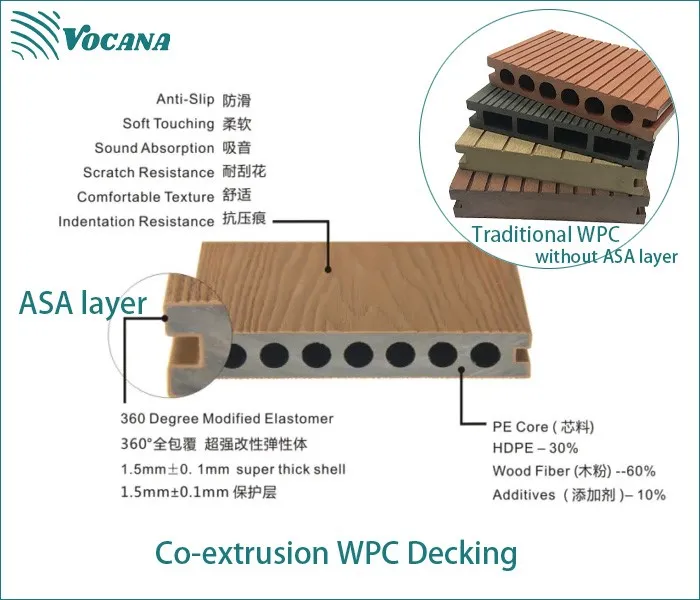
Co-extruded WPC decking with protective cap technology absorbs significantly less contamination than uncapped composite decking, reducing visible staining after repeated exposure cycles.
Surface scratches on textured WPC boards can often be corrected using fine steel wool or 180–240 grit sandpaper applied parallel to the embossed grain direction.
Mold contamination on commercial decks is usually caused by organic residue accumulation and poor drainage rather than WPC substrate failure.
Why Surface Maintenance Matters in Commercial Projects
Facility managers increasingly evaluate exterior materials based on Total Cost of Ownership (TCO), not only the initial installation price.
Typical maintenance issues include:
Wine spills at hotel rooftop bars
Cooking oil contamination in restaurant terraces
Mold growth in humid coastal climates
Furniture movement scratches
Dust accumulation around public plazas
For traditional timber systems:
| Performance Factor | Natural Hardwood | composite decking |
|---|---|---|
| Annual oil treatment | Required | Not required |
| Surface mold sensitivity | High | Moderate–Low |
| Water absorption | 15–30% | Usually below 2–5% |
| Scratch repair process | Recoating required | Localized repair |
| Maintenance labor frequency | High | Lower |
For large hospitality projects, maintenance labor frequently exceeds original material cost over a 10–15 year period.
How to Clean Wine, Grease, and Mold from WPC Surfaces
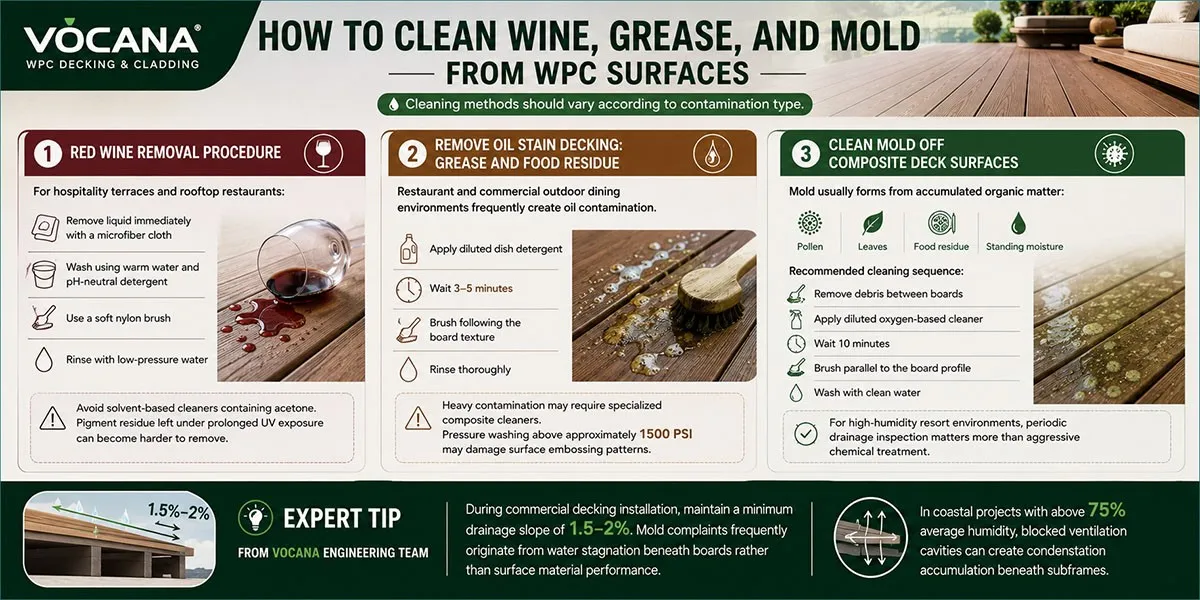
Cleaning methods should vary according to contamination type.
Red Wine Removal Procedure
For hospitality terraces and rooftop restaurants:
Remove liquid immediately with a microfiber cloth
Wash using warm water and pH-neutral detergent
Use a soft nylon brush
Rinse with low-pressure water
Avoid solvent-based cleaners containing acetone.
Pigment residue left under prolonged UV exposure can become harder to remove.
Remove Oil Stain Decking: Grease and Food Residue
Restaurant and commercial outdoor dining environments frequently create oil contamination.
Field procedure:
Apply diluted dish detergent
Wait 3–5 minutes
Brush following the board texture
Rinse thoroughly
Heavy contamination may require specialized composite cleaners.
Pressure washing above approximately 1500 PSI may damage surface embossing patterns.
Clean Mold Off Composite Deck Surfaces
Mold usually forms from accumulated organic matter:
Pollen
Leaves
Food residue
Standing moisture
Recommended cleaning sequence:
Remove debris between boards
Apply diluted oxygen-based cleaner
Wait 10 minutes
Brush parallel to the board profile
Wash with clean water
For high-humidity resort environments, periodic drainage inspection matters more than aggressive chemical treatment.
Expert Tip from Vocana Engineering Team:
During commercial decking installation, maintain a minimum drainage slope of 1.5–2%. Mold complaints frequently originate from water stagnation beneath boards rather than surface material performance. In coastal projects with above 75% average humidity, blocked ventilation cavities can create condensation accumulation beneath subframes.
Repairing Surface Scratches on WPC Boards
Surface scratches occur during:
Furniture movement
Construction traffic
Equipment transport
Metal object impact
Unlike painted timber, many WPC boards allow localized restoration.
Repair Scratched WPC Using Fine Abrasion Methods
Recommended process:
Light scratches
Use fine steel wool
Follow the embossed wood grain direction
Apply moderate pressure
Medium scratches
Use 180–240 grit sandpaper
Sand only affected area
Blend gradually into the adjacent texture
Avoid circular sanding patterns.
Random movement creates visible reflective differences under sunlight.
For embossed boards, restoring directional texture matters more than removing every visible mark.
Why Co-Extruded WPC Resists Stains Better
Not all composite boards perform equally.
Traditional uncapped WPC boards expose wood fiber content directly to environmental contamination.
Co-extruded WPC decking introduces an additional protective shell layer:
Polymer protective cap
Lower moisture absorption
Reduced pigment penetration
Increased stain resistance
Easier cleaning process
Typical cap-layer properties include:
| Property | Standard WPC | Co-extruded WPC |
|---|---|---|
| Surface water absorption | Higher | Lower |
| Wine stain retention | Moderate | Low |
| Mold attachment tendency | Moderate | Lower |
| Cleaning frequency | Higher | Reduced |
Protective cap technology becomes particularly relevant in hospitality environments where food contamination is frequent.
Case Reference: Coastal Resort Exposure Scenario
Vocana engineering teams worked with resort applications exposed to:
Chloride-rich marine air
Continuous UV radiation
High humidity cycles
Airborne particles
Project observations from coastal environments showed:
Stable board geometry
Reduced visible contamination accumulation
Lower maintenance frequency
Lower moisture penetration rates
The co-extrusion protective cap demonstrated improved performance during repeated wet-dry cycling conditions.
In projects near tropical coastlines, maintenance teams reported reduced cleaning labor requirements compared with exposed timber systems.
Vocana Engineering Experience and Material Validation
Material selection increasingly requires evidence beyond catalog specifications.
Vocana project engineering workflows generally include:
Installation spacing calculation
CAD detailing support
Thermal expansion evaluation
Project-specific fixing layout
SGS test documentation
QUV weathering reports
Fire performance data
For architects, specification decisions increasingly rely on measurable entities:
Thermal expansion coefficient
MPa bending strength
N/mm² load resistance
ASTM test procedures
EN fire classification
UV aging performance
This documentation contributes directly to evaluation and material compliance review.
For projects targeting sustainable building materials and Sustainable building products, lifecycle durability and reduced maintenance cycles remain increasingly important specification metrics.
FAQ for WPC decking maintenance
What is the recommended cleaning procedure when a rooftop restaurant deck experiences wine spills, cooking oil contamination, and mold accumulation simultaneously?
Begin with debris removal and pH-neutral detergent cleaning. Treat oil residue separately using grease-removal detergent. Apply oxygen-based mold cleaner only after surface contaminants are removed. Multi-stage cleaning prevents chemical interaction and improves stain removal efficiency.
How should contractors repair scratched WPC boards after construction equipment movement damages textured deck surfaces?
Use fine steel wool or 180 to 240 grit sandpaper parallel to the board grain. Never sand across the embossing direction. Local texture consistency matters more than complete scratch removal because sunlight can highlight differences in surface reflections.
Does co-extruded WPC decking actually perform better than standard composite decking in restaurant and hospitality projects?
Co-extruded cap technology creates a polymer shield over the composite core. This layer limits moisture entry and reduces pigment penetration. Projects with food exposure typically report lower cleaning frequency and reduced visible staining over time.
Why does mold appear on composite decking even though WPC materials have low moisture absorption values?
Mold commonly develops from trapped organic debris and poor ventilation conditions. Leaves, pollen, and standing water create localized growth environments. The issue often relates to drainage design rather than composite material performance.
What maintenance schedule should facility managers adopt for commercial WPC decking systems?
Quarterly cleaning and drainage inspection generally prevents long-term contamination. High-traffic hospitality environments may require monthly inspections around food-service zones and landscape transition areas.
Which material characteristics should architects review before specifying sustainable building products for outdoor commercial decks?
Evaluate thermal expansion coefficient, UV weathering reports, fire ratings, water absorption, bending strength, and maintenance requirements. Long-term operational cost frequently determines overall project value more than material purchase cost.
Engineering Recommendation
For commercial exterior environments, the discussion should move beyond whether a decking board can resist stains. The more relevant question is whether the surface system can maintain appearance quality after years of UV exposure, contamination cycles, and maintenance activity.
Send your CAD drawings for a free project takeoff review. Request engineering-grade WPC samples, installation details, TDS files, and SGS laboratory reports from Vocana to validate specification decisions before project procurement begins.
You Might Also Like
-

Hollow WPC Decking for Public Parks & Boardwalk Pathways ...
-
Exterior Wood Grain WPC Composite Decking for Commercial ...
-

Interior WPC Slatted Wall Panels for Acoustic Offices & H...
-
Modular WPC Wall Partition System for Interior Layouts | ...
-
Thermal Insulated Waterproof WPC Siding for US & Canada T...
-

Moisture-Resistant WPC Decorative Screen for Restaurant P...