


Hidden Fasteners for Cladding vs Screws | WPC Guide
May 18, 2026
Hidden Clips vs. Screws: Which is Best for WPC Cladding?

Commercial facade systems rarely fail because of the cladding panel itself. Most failures begin at the fixing point. For architects and contractors specifying Hidden fasteners for cladding, the decision between concealed clips and exposed screws directly affects installation speed, thermal movement, maintenance budgets, and long-term appearance.
On large-scale commercial projects, improper fixing methods often create visible waviness, stress cracking, panel deformation, and costly rework after thermal cycling. In high UV and coastal environments, these risks become even more significant.
Key Takeaways for Architects & Contractors
Hidden stainless-steel clip systems can reduce installation time by 20–35% compared with exposed screw fixing in large facade areas.
WPC profiles may experience thermal expansion rates of approximately 3–5 mm per meter under temperature variation; clip systems provide controlled movement tolerance.
Exposed screw points can become stress concentration areas after repeated thermal cycles and UV exposure, particularly on south-facing facades.
Hidden Clips vs Screws: Performance Comparison
Choosing between concealed clips and exposed screws is not simply an aesthetic decision. The fixing method directly influences thermal behavior, maintenance frequency, and installation efficiency.
| Performance Factor | Hidden Fasteners | Exposed Screws |
|---|---|---|
| Visual appearance | Continuous clean façade lines | Visible fixing points |
| Installation speed | Faster on repetitive layouts | Slower alignment process |
| Thermal expansion accommodation | Controlled movement gap | Restricted movement |
| Panel replacement | Individual panel access | Multiple panels may require removal |
| Water drainage | Open the ventilation cavity | Can create localized moisture retention |
| Risk of surface cracking | Lower | Higher |
| Long-term maintenance | Lower | Higher |
For commercial projects exceeding 500 m² of facade area, installation efficiency alone can significantly influence labor cost calculations.
Thermal Expansion Matters
Composite cladding behaves differently from cement board or aluminum systems.
Typical co-extruded WPC profiles can experience:
Expansion coefficient: approximately 3–4 ×10⁻⁵ /°C
Surface temperature under Middle East sunlight: 65–75°C
Annual thermal movement cycles: thousands
When screws penetrate the profile directly, thermal movement becomes concentrated around one fixed point. Over time, stress accumulates.
Hidden clips create a controlled floating installation system.
This approach allows:
Uniform movement
Reduced panel distortion
Stable reveals gaps
Lower stress around fixing locations
For large-format facade systems, movement tolerance often determines whether the project remains visually stable after several years.
Vocana Stainless Steel Clip System
Vocana engineering teams have developed dedicated fastening components specifically for commercial composite cladding systems.
The assembly includes:
304 stainless steel hidden clips
Corrosion-resistant screws
Calibrated spacing blocks
Drainage cavity accessories
Aluminum or galvanized steel substructure options
Unlike generic fastening components, dedicated clip geometry is engineered to match profile dimensions and thermal behavior.
Testing considerations include:
Salt spray testing
Thermal cycling
Pull-out resistance
Wind-load verification
UV exposure simulation
For coastal resort projects, stainless steel hardware becomes particularly important because chloride exposure can accelerate corrosion around fixation points.
Expert Tip from Vocana Engineering Team:
On south-facing facades with panel lengths exceeding 2.9 meters, maintain a minimum movement allowance of 8–10 mm at termination zones. Do not rigidly fix both panel ends. One locked point with one floating point reduces stress accumulation and minimizes wave deformation after repeated UV heat cycles.
Installation Speed Test: Hidden Clips vs Screws
On commercial projects, labor often exceeds material savings.
A field installation comparison conducted on repetitive facade modules showed measurable differences.
Exposed Screw Method
Position panel
Measure fixing points
Drill pilot holes
Align screw depth
Check reveal consistency
Average installation speed:
Approximately 12–15 m² per installer/day

Hidden Clip Method
Position starter profile
Insert clip
Tighten screw
Slide next panel
Average installation speed:
Approximately 16–20 m² per installer/day
The difference becomes significant in hotels, commercial plazas, and mixed-use developments.
Case Scenario: Coastal Hospitality Development
A resort project in a high-salinity coastal environment required facade materials capable of resisting:
UV radiation
Salt spray exposure
High humidity
Annual temperature fluctuations
The specification team selected co-extruded UV-resistant WPC cladding installed with concealed stainless-steel fasteners.
After installation:
No visible screw staining
Stable facade alignment
Reduced maintenance inspections
Continuous ventilation cavity behind facade
Because the clip system allowed movement, the facade maintained consistent spacing during seasonal temperature changes.
This directly influenced total ownership cost calculations.
Why Fixing Systems Affects Energy-Efficient Facade Performance
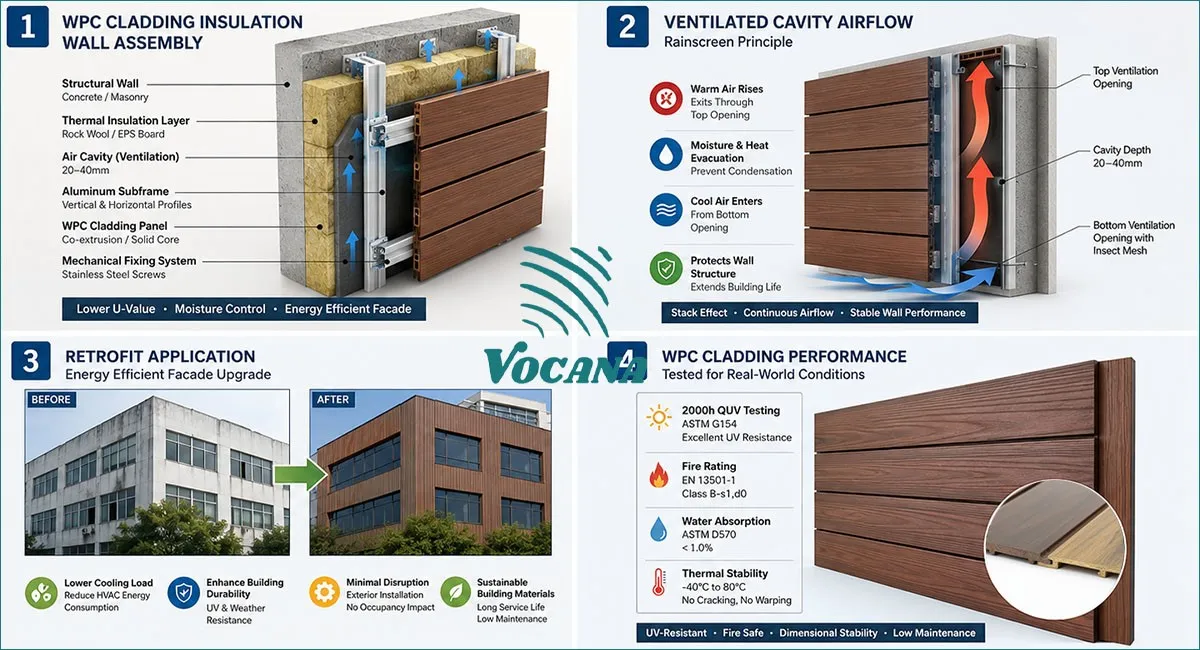
Many discussions around energy-efficient facade systems focus only on insulation.
However, the fixing strategy also influences thermal performance.
Proper hidden clip systems can create:
Rear ventilation cavities
Pressure equalization zones
Reduced moisture accumulation
Improved airflow behind cladding panels
This rain-screen behavior contributes to building envelope efficiency.
For architects pursuing environmentally responsible specifications, installation details are as important as panel composition.
Vocana Experience in Project Engineering
Vocana engineering teams regularly support facade projects in:
Coastal hospitality developments
Middle East commercial plazas
Municipal public facilities
Mixed-use architecture
Project support includes:
CAD fixing details
Wind load calculations
Installation drawings
TDS documentation
SGS test reports
Thermal movement guidance
Rather than specifying materials solely by appearance, facade systems should be evaluated as integrated assemblies.
The combination of profile geometry, substructure design, and fastening methods determines long-term performance.
FAQ for composite cladding installation
What is the required joist spacing for composite cladding installation on commercial facade systems exposed to high wind loads?
Spacing depends on profile geometry and local wind pressure calculations. Typical vertical substructure spacing ranges from 400–600 mm center-to-center. High-rise or coastal projects may require closer intervals after structural verification and pull-out resistance calculations.
How much thermal movement should architects consider when designing long-span WPC façade panels?
Commercial co-extruded WPC systems may expand approximately 3–5 mm per meter, depending on the temperature range. Expansion gaps should be incorporated at panel ends, corner transitions, and termination details to avoid buckling and stress concentration.
Are hidden fasteners stronger than exposed screws for composite cladding systems?
Strength depends on system design rather than hardware visibility. Properly engineered stainless steel clip systems distribute movement and load more evenly, while exposed screws create concentrated fixing points that may experience fatigue over repeated thermal cycles.
Can UV-resistant WPC cladding be installed in Middle East commercial developments with extreme solar exposure?
Yes. Systems tested through 2000-hour QUV accelerated weathering and co-extrusion protective cap technology are commonly used in high-UV environments. Color stability and movement calculations should still be incorporated during design.
How do hidden fasteners influence long-term façade maintenance budgets?
Concealed fixing systems eliminate visible screw corrosion and reduce stress around fixing points. This lowers inspection frequency, minimizes panel replacement work, and improves long-term ownership cost calculations across commercial developments.
Which fixing system is better for sustainable building materials and rain-screen façade design?
Hidden clip systems generally support better drainage cavities and rear ventilation airflow. Combined with recyclable composite profiles and low-maintenance design, they contribute to practical specification strategies for sustainable building products.
Engineering Recommendation
As facade systems continue moving toward rain-screen assemblies and lower lifecycle maintenance requirements, fixing methods should be evaluated as structural components rather than accessories. The lowest hardware cost rarely delivers the lowest ownership cost.
For upcoming projects, send your facade CAD drawings to the Vocana engineering team for a free fixing layout review, quantity estimate, and installation assessment. Engineering-grade WPC samples, TDS sheets, and SGS test reports are also available to support project specifications.
You Might Also Like
-

Urban Balcony WPC Flooring for Apartments in Europe & Mid...
-

Fire-Retardant Slatted WPC Cladding for Commercial Facade...
-

Waterproof Tropical WPC Wall Cladding for Coffee Bars in ...
-

High Compression Strength WPC Cladding for Industrial Par...
-

Composite Decorative Wall Panels for Theme Parks & Retail...
-
Custom Exterior WPC Cladding for Coastal Resorts & Pavili...