

WPC & Lighting: Integrating LED Steps and Deck Lights
Apr 14, 2026
WPC & Lighting: Integrating LED Steps and Deck Lights

Pre-engineered lighting integration reduces installation time by 20–35% compared to post-install retrofits.
Proper drilling techniques in WPC prevent micro-cracking and long-term deformation, especially under thermal expansion.
Hollow WPC substructures allow concealed wiring, improving aesthetics while reducing maintenance risk.
Low-voltage (12V/24V) LED systems are the industry standard for outdoor decking due to safety and energy efficiency.
Integrated deck lighting increases project value perception and resale appeal, especially in hospitality and commercial landscapes.
Vocana's controlled extrusion density and cavity design improve cable routing efficiency and fastening stability.
Why Lighting Integration Matters in Modern Decking Projects
For contractors and developers, deck lighting is no longer decorative - it's functional infrastructure.
In commercial terraces, resorts, and public walkways, outdoor step lighting is tied directly to safety compliance (e.g., slip visibility, edge definition). Meanwhile, LED composite decking systems are increasingly specified in tender documents due to their low maintenance lifecycle.
From a cost perspective:
Retrofitting lighting after decking installation increases labor by 30–50%
Improper cable routing leads to high failure rates within 2–3 years
Integrating lighting at the design stage is now a marginal decision - not just a design choice.
Drilling Guide: How to Cut and Prepare WPC for LED Fixtures
Incorrect drilling is one of the top causes of callbacks in deck lighting projects.
Tool Selection
Carbide-tipped hole saws (recommended for precision cuts)
Step drill bits for small-diameter cable entries
Variable-speed drills (avoid high RPM overheating)
Key Technical Considerations
Optimal drilling speed: 800–1500 RPM, depending on profile density
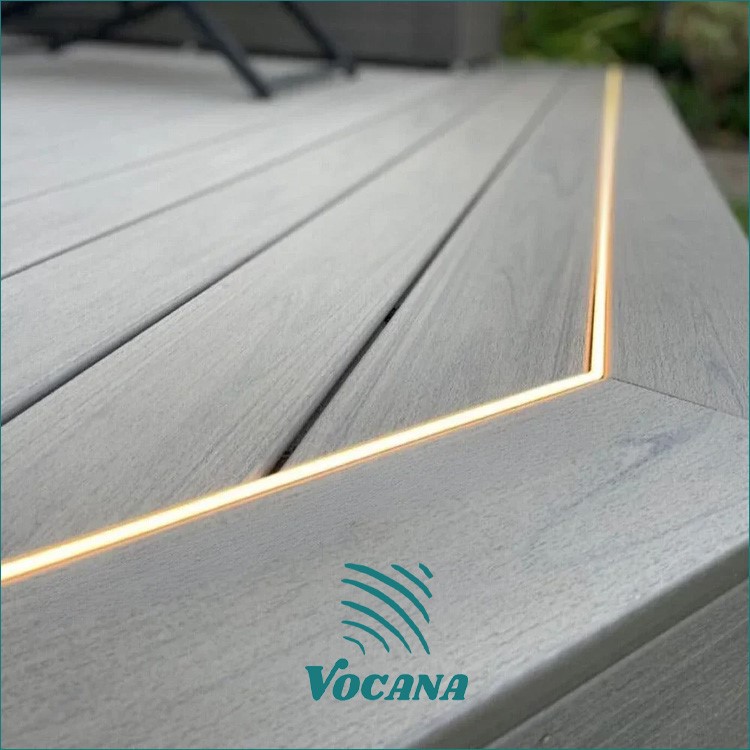
Thermal expansion gap: Leave 2–3 mm clearance around embedded fixtures
Edge distance: Minimum 15 mm from board edge to prevent structural weakening
Common Mistakes to Avoid
Forcing high-speed drilling → causes melting and edge deformation
No pre-drilling → leads to surface cracking under load
Tight-fit fixtures → restrict expansion and cause long-term warping
Vocana Insight:
Vocana's WPC boards are engineered with uniform fiber dispersion and stabilized polymer ratios, tested under internal protocols aligned with ASTM D7032 (decking performance). This ensures predictable drilling behavior across batches - critical for large-scale projects.
Wiring Strategy: Concealing Cables in Hollow WPC Substructures
Efficient cable management is where professional installations differentiate from low-cost builds.
Recommended Approach
1. Use Hollow Joists for Cable Routing
Vocana's hollow WPC joists allow:
Internal cable passage without external conduits
Reduced UV exposure → longer cable lifespan
2. Separate Power and Signal Lines
Maintain at least 50 mm spacing to avoid interference
Use IP67-rated connectors for all junction points
3. Pre-plan Access Points
Install removable decking sections near transformers
Avoid fully sealed systems that require destructive maintenance
Typical Wiring Layout (Commercial Deck)
| Component | Specification | Notes |
|---|---|---|
| Power Supply | 12V / 24V DC transformer | Centralized, weather-protected |
| Cable Type | Outdoor-rated low-voltage cable | UV-resistant, IP67 |
| Routing Method | Inside hollow joists | Hidden, protected |
| Fixture Spacing | 1.5–3 meters (steps: every riser) | Based on the lux requirements |
| Control System | Timer / smart controller | Optional for energy savings |
Result:
Cleaner installation
Lower maintenance cost
Faster inspection approval
LED Composite Decking: Fixture Integration Options
Different projects require different lighting approaches. Choosing the wrong type impacts both cost and durability.
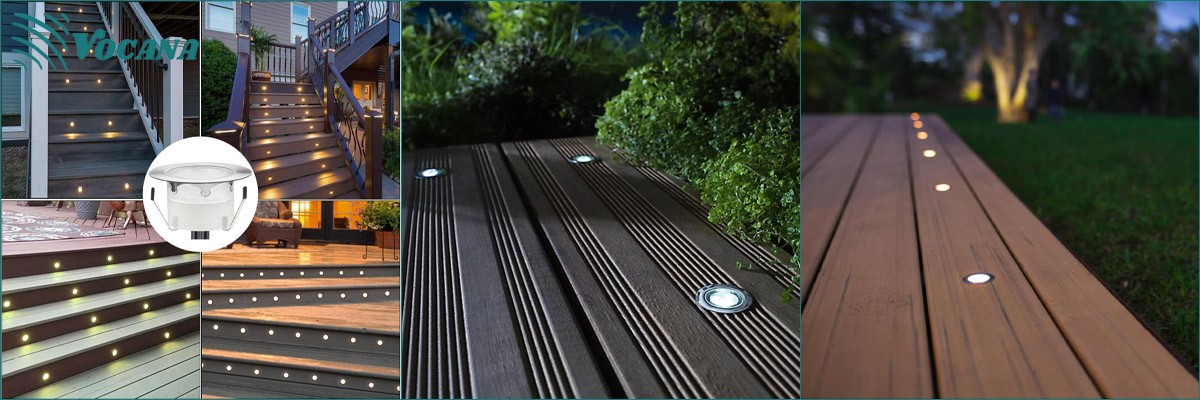
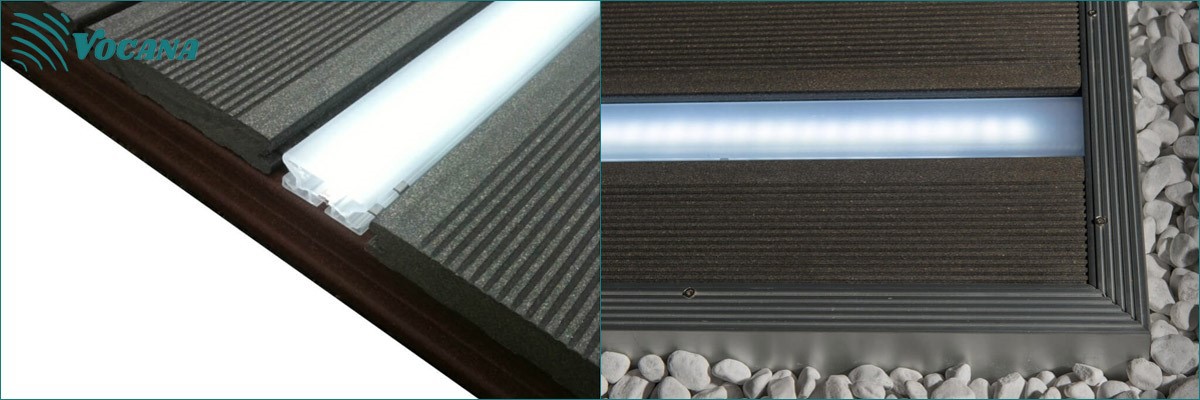
Common Fixture Types
| Lighting Type | Application Scenario | Installation Complexity | ROI Impact |
|---|---|---|---|
| Recessed Deck Lights | Flat decking areas | Medium | High |
| Step Lights | Staircases, elevation changes | Low | Very High |
| Strip Lighting | Under-rail / edge highlighting | High | Medium |
| Post Cap Lights | Railings and perimeter | Low | Medium |
Key Insight:
Step lighting delivers the highest ROI in commercial projects due to safety compliance and visual impact.
Night Project Showcase: Vocana Client Installations
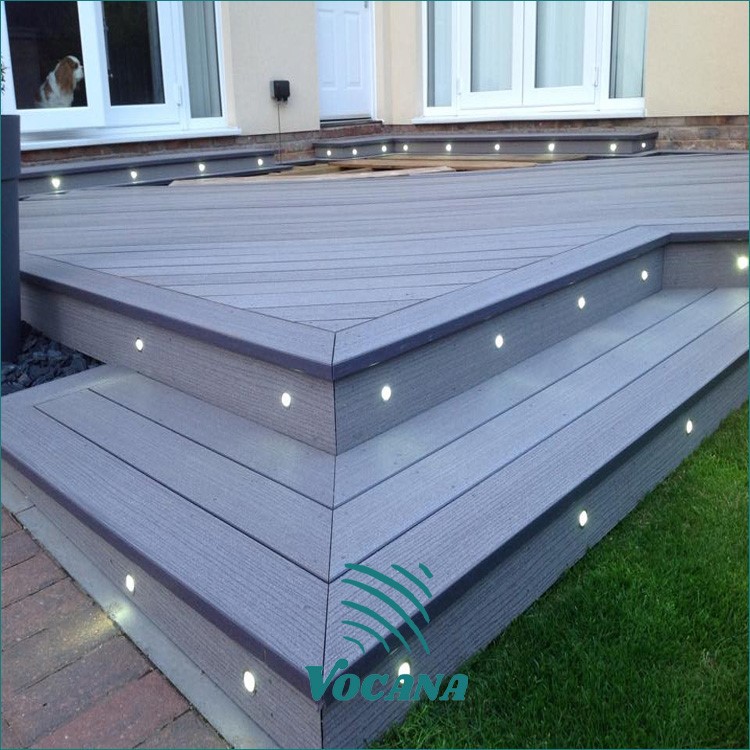
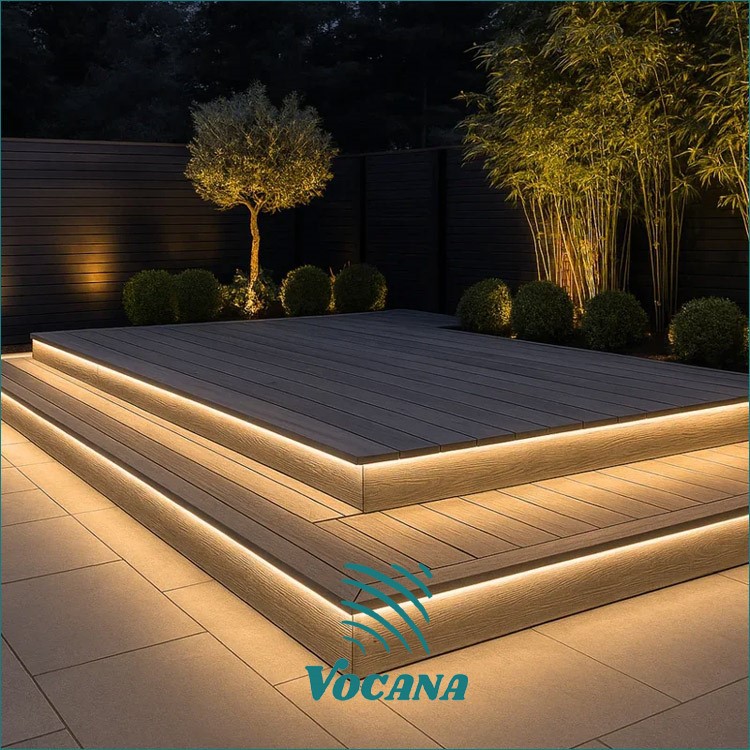
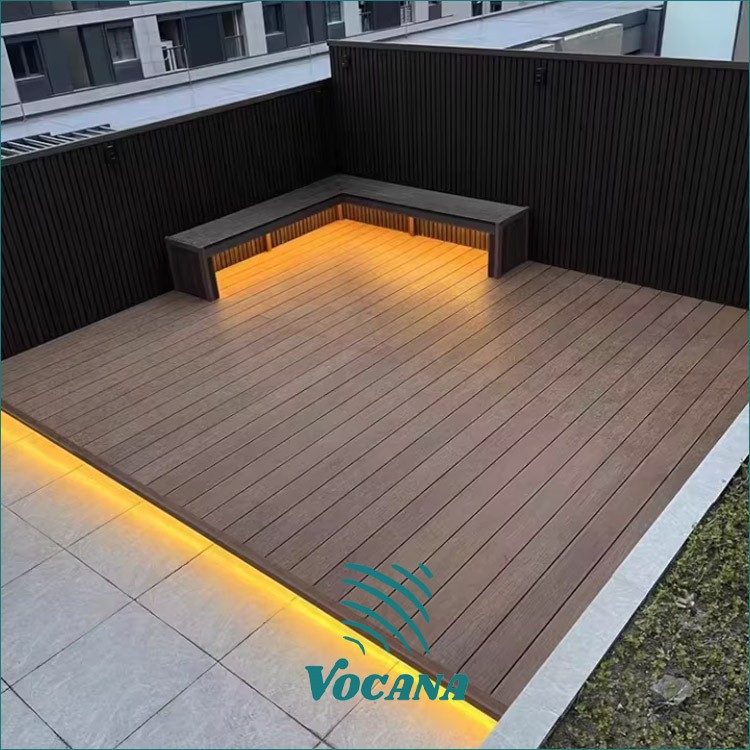
Across Southeast Asia and the Middle East, Vocana WPC decking systems are widely used in:
Hotel rooftop terraces
Waterfront promenades
Residential developer shows units
Typical Results Observed:
30% reduction in customer complaints related to nighttime visibility
Increased tenant satisfaction in mixed-use developments
Improved project photography → stronger marketing assets for developers
Vocana supports these projects with:
Pre-machined panel customization for lighting fixtures
Factory-direct extrusion control for consistent cavity alignment
Engineering consultation for lighting + decking integration
Cost & Profit Perspective for Contractors and Distributors
Lighting integration is not just a cost - it's a profit lever.
Cost Breakdown (Simplified)
| Item | Standard Deck | Deck + LED Integration |
|---|---|---|
| Material Cost | 100% | 115–130% |
| Installation Labor | 100% | 110–120% |
| Maintenance (5 years) | High | Low |
| Project Value Perception | Medium | High |
| Margin Potential | Baseline | +15–25% |
Conclusion:
Integrated lighting systems consistently deliver higher margins, especially in premium or commercial bids.
Installation Notes from Vocana Engineering Team
Always test lighting systems before final board locking
Use removable clips in key maintenance zones
Avoid mixing incompatible materials (PVC + WPC expansion mismatch)
Maintain drainage paths - water accumulation is the #1 cause of electrical failure
With over a decade of export manufacturing, Vocana operates:
High-capacity extrusion lines for consistent WPC density control
In-house testing labs simulating UV, moisture, and load conditions
Custom mold development for project-specific lighting integration
applications & project cases


FAQ: Deck Lighting with WPC Systems
1. Can you install LED lights after WPC decking is already installed?
Yes, but it increases labor cost significantly and may require cutting finished boards, which risks structural integrity. Pre-installation integration is strongly recommended.
2. What voltage is safest for outdoor deck lighting?
12V or 24V low-voltage systems are industry standard for safety and compliance in wet environments.
3. Will drilling weaken WPC boards?
Not if done correctly. Following proper spacing and using the right tools ensures no measurable loss in structural performance.
4. How do you prevent water damage to wiring?
Use IP67-rated connectors, maintain drainage gaps, and avoid sealing cables inside non-ventilated cavities.
5. Is LED composite decking suitable for high-traffic commercial projects?
Yes. When combined with a compliant substructure design, it meets performance expectations aligned with ASTM D7032 load standards.
6. How does lighting affect long-term maintenance costs?
Properly installed systems reduce maintenance frequency by improving visibility and preventing accidents, while protecting cables from environmental exposure.
For project-specific lighting integration drawings, cable routing layouts, or pre-machined decking solutions:
Contact Vocana's engineering team for a free sample box and 2026 installation guide.
--- Kris, Vocana WPC
You Might Also Like
-
WPC Ceiling Panels for Middle East Airport Halls & Commer...
-

Durable Low-Maintenance WPC Fence Panels for Residential ...
-

Eco Slat WPC Interior Wall Panels for Museums & Exhibitio...
-

Wholesale Commercial WPC Timber Siding for Office Complex...
-

Waterproof Tropical WPC Wall Cladding for Coffee Bars in ...
-

Wear-Resistant WPC Gym Partition Panels for Fitness Studi...