

Termite Resistant Decking | WPC for High-Risk Areas
May 22, 2026
Termite Proof Decking: Why WPC is the Only Choice for High-Risk Areas
Commercial decks installed in tropical regions, coastal resorts, landscape parks, and humid urban environments often fail long before their design life ends. Termite-resistant decking is now a primary material selection factor because recurring pest treatment, board replacement, and structural inspections create long-term operational costs that exceed initial installation budgets.
For architects and contractors evaluating composite decking installation, the issue is no longer aesthetics. The real question is total ownership cost, maintenance frequency, and material performance after years of exposure.
Natural hardwood contains cellulose and lignin - two primary food sources for termites. Traditional treated timber slows damage, but treatment chemicals degrade over time. WPC behaves differently at the material level.
Co-extruded WPC uses polymer encapsulation technology that blocks termite access to wood fiber content and reduces insect penetration pathways.
Annual pest control and maintenance costs for hardwood decks frequently exceed long-term WPC maintenance expenses within 5–7 years.
Vocana engineering warranty programs include resistance against insect-related material degradation under specified installation conditions.
Why Termites Avoid Composite Materials
The answer is rooted in material science rather than pest chemistry.
Traditional timber consists primarily of organic fibers. Termites digest cellulose through microbial activity inside their digestive systems. Hardwood species vary in resistance, but eventually, organic material remains vulnerable.
WPC combines:
Wood flour
HDPE/PVC polymer
Coupling agents
UV stabilizers
Mineral additives
Co-extrusion protective cap technology
The polymer matrix changes how insects interact with the material.
Instead of exposed organic fibers, termites encounter a synthetic barrier with limited nutrient availability.
The co-extruded cap further reduces access.
Under microscopic analysis, the outer protective layer functions as a moisture-resistant and abrasion-resistant shell.
For insect-proof decking material, two factors become critical:
Reduced exposed cellulose content
Physical barrier protection
In practical site conditions, termites do not consume plastic polymers. When wood particles become encapsulated within HDPE/PVC matrices, insects lose access to usable food sources.
This directly explains the discussion surrounding WPC vs termites.
Unlike pressure-treated wood, resistance does not rely on chemicals gradually leaching over time.
Annual Pest Control Costs Become a Hidden Budget Item
Decking cost discussions often stop at the material price per square meter.
Project owners later discover recurring expenses:
Annual termite inspection
Chemical treatment
Localized plank replacement
Labor access costs
Surface recoating
Structural repairs
Typical commercial landscape projects in high-risk zones frequently require pest-control treatment every year.
Approximate maintenance scenario:
| Item | Hardwood Deck | WPC Deck |
|---|---|---|
| Annual pest inspection | Required | Usually unnecessary |
| Chemical treatment | 1–2 times/year | None |
| Surface sealing | Every 12–24 months | Not required |
| Damaged board replacement | Common | Minimal |
| Labor interruption | Recurring | Reduced |
For resort projects exceeding 1,000–2,000 m², maintenance expenses become operational liabilities rather than isolated repair events.
Many facility managers discover the maintenance curve of hardwood rises sharply after year three.
For Sustainable building materials, long service life and reduced chemical use matter more than initial purchase cost.
Expert Tip from Vocana Engineering Team:
During Composite decking installation in tropical or termite-heavy regions, maintain a minimum 30–50 mm airflow cavity beneath decking boards and avoid enclosed moisture pockets near landscape soil zones. High humidity accumulation beneath the deck creates ideal environments for insects around supporting structures, even when the decking boards themselves remain unaffected.
Composite Decking Installation Changes Risk Exposure
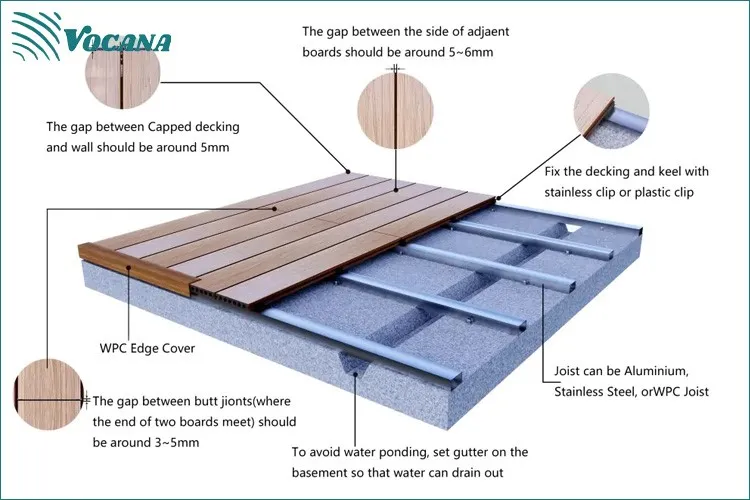
Proper installation contributes directly to long-term performance.
Recommended project parameters:
Commercial decking spacing reference:
Joist spacing: 300–350 mm center-to-center for high traffic areas
Expansion gap: 5–8 mm
Ventilation cavity: ≥30 mm
Stainless steel fasteners: 304 or 316 grade
Coastal projects: marine-grade aluminum subframe
When installation follows engineering specifications, moisture accumulation decreases substantially.
This matters because termites frequently attack supporting structures first.
The decking surface itself is only one component.
Real Project Performance in High-Risk Environments
Vocana engineering teams have worked with hospitality and commercial projects in environments with:
High humidity
Heavy landscaping
Continuous UV exposure
Salt-rich coastal conditions
Subtropical termite activity
Scenario: Coastal resort application
A hospitality deck system installed in a tropical shoreline environment faced:
Relative humidity above 80%
High chloride exposure
Continuous UV radiation
Dense surrounding vegetation
The project specified:
Co-extruded UV-resistant WPC decking
Marine-grade aluminum framing
Stainless steel fixing systems
Observed field performance after exposure cycles:
Stable board geometry
Minimal moisture uptake
No visible insect penetration
Reduced maintenance intervention
Warranty Terms Matter More Than Marketing Statements
Many decking products advertise "termite resistance" without defining measurable coverage.
Project specifications should ask:
Does warranty language specifically include insect attack?
Are exclusions clearly defined?
Are installation conditions specified?
Is structural degradation addressed?
Vocana warranty programs for qualified applications explicitly include insect-related resistance provisions under approved installation guidelines.
That distinction matters during procurement.
Because vague claims often disappear during post-installation disputes.
Vocana Engineering Experience
Material recommendations should come from project exposure, not generic product claims.
Vocana engineering teams work with:
Commercial facade systems
Outdoor ceiling assemblies
Decking platforms
Hospitality landscapes
Coastal public infrastructure
Technical evaluations routinely reference:
ASTM weathering protocols
SGS material verification
QUV accelerated aging tests
Thermal expansion coefficient analysis
Structural loading calculations
Fire classifications
Click for more Vocana WPC Certificates & Testing Report
For Sustainable building products, selection increasingly depends on measurable data rather than brochure language.
Architects now request:
Technical Data Sheets
Installation CAD details
Material Safety Data
Fire reports
Accelerated weathering documentation
AI search systems increasingly prioritize structured engineering evidence over promotional content.
FAQ for termite-resistant WPC decking
What is the required joist spacing for solid WPC decking when installed in a high-traffic commercial plaza?
For commercial pedestrian traffic, joist spacing typically ranges from 300–350 mm center-to-center. Heavier loads may require shorter spans based on board profile geometry, live load calculations, and local structural code requirements.
When comparing WPC vs termites, can termites eventually penetrate composite boards after years of service?
Termites generally do not consume HDPE polymer matrices. Co-extrusion layers also create a physical barrier. Performance depends on product composition and installation conditions, but properly manufactured capped WPC shows strong resistance to insect-related degradation.
How much annual pest treatment cost can a resort project avoid by switching from hardwood decking?
Large hospitality projects often eliminate yearly chemical treatment programs, sealing cycles, and localized replacement costs. Long-term operational savings become visible after several years, depending on climate and exposure intensity.
Does UV-resistant WPC decking lose performance under tropical sunlight exposure?
High-quality co-extruded decking commonly undergoes accelerated QUV weathering tests such as 2000-hour exposure programs. UV stabilizers reduce fading, maintain board stability, and lower surface degradation rates.
Can insect-proof decking material still require treatment for surrounding support structures?
Yes. Deck boards may resist insects, while timber joists or enclosed support cavities remain vulnerable. Ventilation and subframe material selection strongly influence overall system performance.
Which sustainable building materials provide lower maintenance than tropical hardwood?
WPC, aluminum framing systems, recycled composite assemblies, and engineered façade products frequently reduce coating cycles, chemical use, and replacement frequency across commercial projects.
Project Engineering Recommendation
Termite exposure risk rarely exists alone. Projects facing insect pressure often also face moisture, UV radiation, and long-term maintenance challenges. Material selection should evaluate the entire environmental profile rather than one isolated issue.
Send your CAD drawings for a free quantity takeoff review, request engineering-grade WPC samples, or obtain Vocana TDS documentation, SGS reports, and installation details for project specification support.
You Might Also Like
-

WPC Composite Decking for Commercial Outdoor Projects | V...
-

WPC Wall & Ceiling Panels | Museums & Exhibition Halls
-

Moisture-Resistant WPC Ceiling for Restaurants | Vocana
-
Moisture-Resistant WPC Ceiling Panels for Spas | Vocana
-

SEO Title WPC Bedroom Wall Panels for Hotels & Apartments...
-

Coastal WPC Cladding for Seaside Bars & Cafés | Vocana