

How to Choose WPC Ceiling Design for Your Project? Tongue and Groove Design vs U-Shaped System
Feb 11, 2026
Key Takeaways of WPC ceiling system

WPC ceiling selection impacts installation speed, maintenance access, fire compliance, and long-term cost control.
Tongue and groove ceilings create a seamless decorative surface, ideal for fully enclosed interior spaces.
U-shaped WPC ceiling systems offer faster installation and easier maintenance, widely used in commercial and semi-outdoor applications.
Closed U-shaped systems provide a solid linear finish; open systems improve ventilation and reduce structural load.
Performance depends on the composite formulation, moisture resistance, and fire rating, not just appearance.
Vocana validates every ceiling batch through density, moisture absorption, flexural strength, and fire testing protocols.
WPC Ceiling Systems: Structural Logic Before Aesthetic Preference
For architects and developers, choosing a decorative ceiling system is not a cosmetic decision. It affects:
Installation man-hours
Structural load calculation
Long-term dimensional stability
Maintenance and panel replacement cost
A wrong selection can increase labor costs by 20% and generate unnecessary after-sales claims.
Two mainstream structural systems dominate the market:
Tongue and groove ceiling
U-shaped WPC ceiling (suspended click-lock system)
Each serves a different engineering purpose.
Understanding WPC Ceiling Material Performance
Before comparing structures, the material composition must be evaluated.
A high-performance, moisture-resistant WPC ceiling typically includes:
60–65% refined wood fiber
30–35% polymer matrix (HDPE or PVC)
5–10% additives (UV stabilizers, coupling agents, fire retardants)
Performance indicators should meet or exceed:
Water absorption (ASTM D570 reference)
Flexural strength (ASTM D790 reference)
Fire classification requirements
Dimensional stability under temperature cycling
At Vocana, internal lab testing shows:
Water absorption rate below 1.2% (24h immersion)
Stable flexural strength across batch production
Fire-retardant formulations are available for fireproof composite ceiling requirements
Material control prevents warping, surface cracking, and long-term sagging.
Tongue and Groove Ceiling System
Structural Characteristics
Tongue and groove panels interlock edge-to-edge, creating a continuous surface without visible gaps.
Technical Advantages
Seamless finish
Strong lateral joint locking
Hidden fastening system
Enhanced structural rigidity
When to Choose Tongue and Groove Ceiling
Recommended for:
Hotel interiors
Residential luxury ceilings
Office lobbies
Enclosed retail environments
Why?
High-end aesthetic continuity
Clean architectural surface
Minimal visual interruption
Considerations
Installation requires precise alignment
Maintenance access is limited after installation
Labor time slightly higher than click systems
For projects prioritizing architectural refinement over maintenance flexibility, this system performs reliably.
U-Shaped WPC Ceiling System

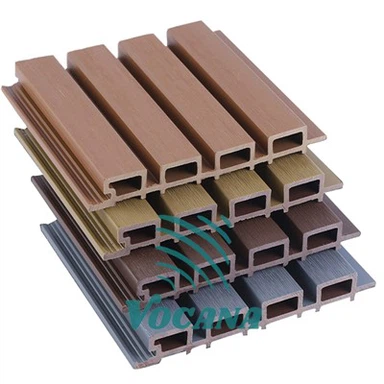
The U-shaped WPC ceiling is a suspended system installed on metal keel structures.
It is widely used in commercial, public, and semi-outdoor applications.
Two Types of U-Shaped Ceiling Systems:
1. Closed U-Shaped Ceiling
Panels are installed with minimal spacing, forming a linear but continuous appearance.
Suitable for:
Shopping malls
Airports
Office corridors
Transportation hubs
Advantages:
Balanced aesthetic and functionality
Conceals substructure effectively
Faster installation compared to tongue and groove
2. Open U-Shaped Ceiling
Panels are spaced apart intentionally, creating airflow channels.
Often includes closed battens (solid slats) in specific sections to adjust visual density.
Suitable for:
Semi-outdoor corridors
Parking structures
Infrastructure projects
Spaces requiring ventilation
Advantages:
Improved air circulation
Lower structural load
Easier access for maintenance
Seamless integration with lighting and sprinkler systems
Direct Comparison: Which System Fits Your Project?
| Parameter | Tongue & Groove Ceiling | Closed U-Shaped | Open U-Shaped |
|---|---|---|---|
| Installation speed | Medium | Fast | Fastest |
| Maintenance access | Limited | Moderate | Excellent |
| Aesthetic effect | Seamless flat | Linear modern | Open linear |
| Ventilation | Low | Moderate | High |
| Structural load | Medium | Light | Lightest |
| Ideal application | Interior decorative | Commercial indoor | Semi-outdoor |
Fire Performance and Moisture Resistance Considerations
When specifying a fireproof composite ceiling, always verify:
Fire classification level
Smoke development rating
Heat release rate
Fire-retardant WPC ceilings can achieve B-class fire performance depending on formulation.
Moisture resistance is critical in:
Tropical climates
Coastal regions
High-humidity commercial zones
Vocana's moisture-resistant WPC ceiling systems undergo:
Controlled humidity chamber testing
Thermal expansion simulation
Accelerated aging tests
This ensures long-term stability and reduces deformation risks.
Cost & Installation Efficiency Analysis
From a project perspective:
U-shaped systems reduce installation time by 15–25%
Labor skill requirements are lower
Maintenance cost over 10 years is significantly reduced
Tongue and groove systems offer stronger aesthetic value but require more precision during installation.
If operational efficiency is a priority → choose a U-shaped WPC ceiling.
If premium visual integration is a priority → choose tongue and groove WPC ceiling.
Vocana's Engineering & Manufacturing Advantage
As a specialized WPC manufacturer serving global contractors and developers, Vocana provides:
Full ceiling system supply (profiles, accessories, structural components)
Custom extrusion capability
Fire-retardant and moisture-resistant formulation options
In-house laboratory testing with batch traceability
Stable large-scale production capacity
Every production batch undergoes:
Density verification
Water absorption testing
Flexural strength analysis
Surface color consistency inspection
Consistency protects contractor profit margins.
For large-scale developments, material stability is more valuable than short-term price savings.

(Vocana's WPC Testing) Click for more testing reports and certificates.
How to Select the Right WPC Ceiling System
1. Choose Tongue and Groove If:
Fully indoor application
High-end decorative finish required
Maintenance access is not frequent
The structural span is limited
2. Choose Closed U-Shaped If:
Commercial corridor environment
Balance between appearance and efficiency
Concealment of the structure is required
3. Choose Open U-Shaped If:
Ventilation is critical
Semi-outdoor environment
Frequent maintenance access expected
Lightweight structural load preferred
FAQ for wPC ceiling system
1. Which WPC ceiling system is more cost-efficient for commercial projects?
U-shaped ceiling systems generally reduce installation labor by 15–25%, making them more cost-efficient for large commercial developments.
2. Can WPC ceilings meet fireproof requirements?
Yes. With fire-retardant additives, WPC ceilings can achieve the required fire classifications depending on regional standards.
3. Is WPC ceiling suitable for humid climates?
High-quality moisture-resistant WPC ceiling panels with controlled water absorption rates perform well in humid or tropical regions.
4. How can buyers verify ceiling quality before purchase?
Request lab reports for density, water absorption, flexural strength, and fire classification. Reputable manufacturers provide batch-level documentation.
Next Step
If you are evaluating a wpc ceiling system for your next commercial or infrastructure project:
Contact Vocana's engineering team for technical drawings, laboratory data, and a customized sample kit.
Or request our 2026 WPC Ceiling Installation & Specification Guide for detailed structural references.
You Might Also Like
-

Timber-Look WPC Ceiling Panels for Offices & Retail | Vocana
-

WPC Composite Cladding for Beach Clubs & Poolside Buildin...
-

Interior WPC Board Cladding for Middle East Airport Termi...
-

Fire-Resistant WPC Wall Panels for Hospitals & Schools | ...
-
Outdoor WPC Slatted Panels for Theme Park Pavilions | Vocana
-

Exterior WPC Composite Wall Panels for Offices & Apartmen...